Oprah Winfrey’s “Big Give” has just finished playing on television. For those who never watched it or saw the promotions for it, Oprah had a number of contestants on the program giving to people in need each week. The person who gave the least or had the least effect was voted off by a high-profile panel of “expert givers”.
What struck me about this was the apparent “backwardness” of the show. Instead of the contestants trying to get the most for themselves they were trying to give the most away.
Why I say this is backward is because in life the status symbols people crave are possessions. Very few would brag about the amount of money they gave to charities last year, though the same people would happily take you to their garage to see their new car or take you on a tour of their home pointing out the various upgrades, or show you the photos from their recent holiday.
Why don’t people proclaim how much they give away?
It’s odd that it’s actually seen as rude to brag about the amount of money one donates, yet it’s not rude to casually discuss the money one spends on oneself.
In an age of abundance and in many cases gluttony, there are still massive portions of the world that struggle daily to even feed themselves.
So it is interesting then that now as our society becomes more conscious of mother earth, of waste and of understanding others, that the status symbols that still thrive are the self-centered, wastefully extravagant kind. We’re all guilty, myself included. In this day and age it’s nearly impossible not to get caught up, especially in a city as wealthy as Calgary is.
“And what’s wrong with that anyway?” You may be asking.
I guess nothing. Everyone makes their own choices as to how they want to allocate their resources, financial or otherwise. People tend to allocate where they see themselves getting the most bang for the buck.
What bang are people looking for when they buy status symbols? Prestige perhaps. Uniqueness. Popularity… even fame. And what will that buy them? Happiness would be the hope, but happiness is rarely if ever the result. True happiness comes from knowing yourself, from self-satisfaction, from making a difference, from contribution to others. Essentially happiness comes from giving.
“The best way to find yourself is to lose yourself in the service of others.” – Mohandas Gandhi.
The problem with all these things that we acquire is they steal time away from us. Last week my automatic garage door stopped working. I know it’s not a status symbol, but it is a sign of abundance. So now I’ll have to get it fixed, so that I can access my garage. If I didn’t have an automatic garage door I wouldn’t be losing any time this week getting it fixed! As a society we run so many errands and make shopping trips to purchase status symbols, or upgrading the ones we bought last year that no longer cut the mustard.
If we replaced that time in acquisition mode with time in giving mode we would likely find ourselves more at peace with the world. In addition to the benefit that would be seen by our friends and family, who would spend more quality time with us, we would also have a fair bit of spare change left over. We could give it away to someone who needs it more than we need to buy yet another flat screen plasma television!
Showing posts with label Published Articles. Show all posts
Showing posts with label Published Articles. Show all posts
Monday, May 05, 2008


Friday, April 04, 2008
Choices (Published Article)
The path we take in life is just that, it’s a path. Where that path goes is completely up to us. We make the choices and decisions which will guide our life in a certain direction.
In fact where we are today is a result of all the decisions and choices we have made up to this time. Look at every aspect of your life and think about how it came to be the way it is. Somewhere along the line you chose that to be a part of your life.
I was thinking about one of the conscious choices I make – my friends. On the weekend we had a party for some of our friends and there were fourteen of us in total. I was paid a compliment by one friend who didn’t know many of the others when she said, “Your friends are really nice people.”
It’s nice when someone pays you a compliment, and especially nice when they compliment your good judgement. We enjoy our friends and although we have only lived in Calgary for five years we have a strong network, which has taken time and energy to build.
I remember when my wife and I first came to Calgary. We didn’t know anyone and on weekends we would stay at home and play board games. Our phone would only ring when a telemarketer called, and I would relish the opportunity to speak with them!
We made a conscious effort to make friends. We played on teams through sporting socials clubs and we looked in every place we could think where friendly people might exist who could become our friends. We were prepared to put in a concerted effort to invite them for dinner or to organize outings together.
As a result we now have a strong network and find ourselves busy on most weekends, spending time with friends. In this column I have previously mentioned the value of time, and I have chosen to spend my time with good friends. These are the sorts of people we can rely on, who are honest and whom we can trust, with whom we have interesting conversations based on common interests and intellect. These are all people I could trust with my children or my wallet. They are people who make us feel special. These are people who enrich our life.
Becoming friends with all of these people took effort on our part, but the rewards are great. As life goes on I see that what makes our lives valuable is less concerned with the monetary wealth we have, but the golden friends around us.
No matter what situation you’re in now with regards to your friends or anything else in your life, ask yourself whether you would choose what you have now if given the opportunity to start fresh.
When you think about your friends could you trust them all? Are they always reliable? Do they ever let you down? Do you respect them? Do you get excited to see them? Do they make you feel good when you’re together? Do they make you feel like you are important to them?
It’s important to respect yourself so that you surround yourself only with the people who deserve your friendship. Along the way we have met many more people than we are now friends with. Our friends today are the ones we consciously chose to become friends with.
So far, the diligent effort and perseverance has resulted in a happy social life for us. Diligent effort and perseverance is a formula for success in any aspect of life.
In fact where we are today is a result of all the decisions and choices we have made up to this time. Look at every aspect of your life and think about how it came to be the way it is. Somewhere along the line you chose that to be a part of your life.
I was thinking about one of the conscious choices I make – my friends. On the weekend we had a party for some of our friends and there were fourteen of us in total. I was paid a compliment by one friend who didn’t know many of the others when she said, “Your friends are really nice people.”
It’s nice when someone pays you a compliment, and especially nice when they compliment your good judgement. We enjoy our friends and although we have only lived in Calgary for five years we have a strong network, which has taken time and energy to build.
I remember when my wife and I first came to Calgary. We didn’t know anyone and on weekends we would stay at home and play board games. Our phone would only ring when a telemarketer called, and I would relish the opportunity to speak with them!
We made a conscious effort to make friends. We played on teams through sporting socials clubs and we looked in every place we could think where friendly people might exist who could become our friends. We were prepared to put in a concerted effort to invite them for dinner or to organize outings together.
As a result we now have a strong network and find ourselves busy on most weekends, spending time with friends. In this column I have previously mentioned the value of time, and I have chosen to spend my time with good friends. These are the sorts of people we can rely on, who are honest and whom we can trust, with whom we have interesting conversations based on common interests and intellect. These are all people I could trust with my children or my wallet. They are people who make us feel special. These are people who enrich our life.
Becoming friends with all of these people took effort on our part, but the rewards are great. As life goes on I see that what makes our lives valuable is less concerned with the monetary wealth we have, but the golden friends around us.
No matter what situation you’re in now with regards to your friends or anything else in your life, ask yourself whether you would choose what you have now if given the opportunity to start fresh.
When you think about your friends could you trust them all? Are they always reliable? Do they ever let you down? Do you respect them? Do you get excited to see them? Do they make you feel good when you’re together? Do they make you feel like you are important to them?
It’s important to respect yourself so that you surround yourself only with the people who deserve your friendship. Along the way we have met many more people than we are now friends with. Our friends today are the ones we consciously chose to become friends with.
So far, the diligent effort and perseverance has resulted in a happy social life for us. Diligent effort and perseverance is a formula for success in any aspect of life.
Saturday, March 01, 2008
Trapped (Published Article)
One of my new year’s resolutions was to read books I have on my shelf that somehow remain unread. It’s part of my de-cluttering and simplifying of my life. I have just finished Anne Frank: The Diary of a Young Girl.
It’s a well-known story of Anne Frank, a young Jewish girl in hiding from 1942 to 1944 with seven other people in a “secret annexe” – secret rooms above an office in Amsterdam. Because their survival relied on as few people as possible knowing that they were there, they had to remain silent throughout the days, not even using water, which might alert the office-workers below that people were hiding upstairs. Every day they worried they could be discovered and taken by the Nazis. To survive they relied on hoping for the war to end and the Nazis to be defeated.
What made me think was how these people were trapped in this life. Anne had been such a friendly, sociable person but was restricted to being friends with the seven others in hiding, two of whom were her parents and one her sister. I started to think about our lives and how we too are trapped – not physically but mentally. Anne was trapped because of her race and the horrible war situation, but how many of us are trapped in our own world. We’re trapped inside our comfort zone.
The limits that exist in our life are the ones we place on ourselves. In general people hold themselves back more often in life because of a lack of confidence than a lack of potential or ability.
Take a moment to think about your life and what you do regularly. How often do you push yourself to the point of being scared or uncomfortable? How often do you try new activities or attempt something that you’ve previously been unsuccessful at?
If you’re not pushing yourself and striving to do new and scary things then you’re not expanding your comfort zone. And the unfortunate part of that is that if it’s not expanding it’s contracting. As children we spend every day expanding our comfort zones and skill levels. Just watch a one-year-old learn to walk. There’s a period of instability, many falls and bumps into table corners but with every injury comes a stronger resolve to try again and become better. Eventually the children master the skill of walking and begin to run and jump. We take walking for granted but there was a point in our life when, as we lay on our stomachs licking dust off the carpet, it may have seemed like an impossible dream.
Somehow as adults we change and stop at the first failure or sign of failure. It appears that the encouraging environment that children grow up in evaporates as adults don’t seem to believe that encouragement is still relevant.
People need encouragement and they need to dream and have people support their dreams. Donald Trump sees that the difference between himself and others is that he thinks big. “I have to think anyway, so I might as well think big.”
Within a positive environment we feel safe thinking big and chasing our goals. Within a supportive environment we feel it is okay to fail along the way. Within an open and loving environment we recognize that we all face similar challenges and have similar worries and concerns and that we’re all here to help each other.
Unlike Anne Frank we are not forced to be a prisoner. Let’s not be imprisoned by self-imposed limits. Throw caution to the wind, take a risk - that leap of faith. Recognize that anything’s possible.
It’s a well-known story of Anne Frank, a young Jewish girl in hiding from 1942 to 1944 with seven other people in a “secret annexe” – secret rooms above an office in Amsterdam. Because their survival relied on as few people as possible knowing that they were there, they had to remain silent throughout the days, not even using water, which might alert the office-workers below that people were hiding upstairs. Every day they worried they could be discovered and taken by the Nazis. To survive they relied on hoping for the war to end and the Nazis to be defeated.
What made me think was how these people were trapped in this life. Anne had been such a friendly, sociable person but was restricted to being friends with the seven others in hiding, two of whom were her parents and one her sister. I started to think about our lives and how we too are trapped – not physically but mentally. Anne was trapped because of her race and the horrible war situation, but how many of us are trapped in our own world. We’re trapped inside our comfort zone.
The limits that exist in our life are the ones we place on ourselves. In general people hold themselves back more often in life because of a lack of confidence than a lack of potential or ability.
Take a moment to think about your life and what you do regularly. How often do you push yourself to the point of being scared or uncomfortable? How often do you try new activities or attempt something that you’ve previously been unsuccessful at?
If you’re not pushing yourself and striving to do new and scary things then you’re not expanding your comfort zone. And the unfortunate part of that is that if it’s not expanding it’s contracting. As children we spend every day expanding our comfort zones and skill levels. Just watch a one-year-old learn to walk. There’s a period of instability, many falls and bumps into table corners but with every injury comes a stronger resolve to try again and become better. Eventually the children master the skill of walking and begin to run and jump. We take walking for granted but there was a point in our life when, as we lay on our stomachs licking dust off the carpet, it may have seemed like an impossible dream.
Somehow as adults we change and stop at the first failure or sign of failure. It appears that the encouraging environment that children grow up in evaporates as adults don’t seem to believe that encouragement is still relevant.
People need encouragement and they need to dream and have people support their dreams. Donald Trump sees that the difference between himself and others is that he thinks big. “I have to think anyway, so I might as well think big.”
Within a positive environment we feel safe thinking big and chasing our goals. Within a supportive environment we feel it is okay to fail along the way. Within an open and loving environment we recognize that we all face similar challenges and have similar worries and concerns and that we’re all here to help each other.
Unlike Anne Frank we are not forced to be a prisoner. Let’s not be imprisoned by self-imposed limits. Throw caution to the wind, take a risk - that leap of faith. Recognize that anything’s possible.
Friday, February 01, 2008
World Peace (Published Article)
World Peace seems like the impossible dream. It doesn’t seem to matter who is driving the cause or how much money is put behind it, attempts at world peace all seem to fail somewhere along the line. That’s not to say that all efforts are in vain. Certainly I’m a big proponent of being friendly and getting along with people where possible.
The interesting thing about the concept of “world peace” is that for there to be peace in the world, there has to also be peace at home. If two brothers can’t get along, then how can we expect people of different races, religions and various backgrounds to cooperate?
I believe that if we can solve the problems at home, we can solve the problems of the world, and the reason is simple. The same reason why two family members don’t see eye to eye is the same reason two countries don’t see eye to eye.
It sounds simplistic, and perhaps it is, but that’s the beauty of it all. There are a couple of principles that if followed would go a long way to eliminating turmoil and wars.
The first is communication -open and honest communication. As I watch my two year old daughter as she’s learning to speak, form sentences and grow her vocabulary, I see how excited she is. Every day she learns something new and she’s just itching to practice. What happens between that age and becoming a teenager when it seems the lines of communication shut down and no one wants to talk any more?
Marriages break down and countries go into war against each other because they fail to remain in consistent communication and let their assumptions take over.
When communication is done well it becomes the strength in a relationship or in an organization, but when it is done poorly it can be single most destructive force. I’ve worked in places that have such poor communication that everything was learned “on the grapevine” or at the water cooler. There was constant gossiping and a lot of ill-feeling, simply because there was a lack of healthy communication from managers and between colleagues.
The second is to try and see things from the other person’s point of view. Most of the arguments (and these very big arguments become wars) that happen are a result of people not putting themselves in the other person’s shoes and making a real attempt to see it from their point of view. Sometimes that means to physically put yourself there – sit in their chair, put on their clothes, spend a day shadowing them. Ask questions why. Be genuinely interested in their life and find out what makes them tick, and why! When you begin asking people questions about their life you will be amazed at how interesting they are. Below the surface there are so many hidden treasures and experiences, it seems a shame that there are very few outlets that will allow them to come forth, and also our reluctance to talk about them.
When you truly understand why someone does something and you can put yourself in their position, you may still not agree with their point of view, but it’s much more difficult to get angry about it.
Often we look to other places to try and solve problems. It’s easier than dealing with our own issues. We complain about the world and we become victims of our environment. If we turned that energy into making the best of our own lives, the one by one we could save the world. World Peace is achievable, one household at a time.
The interesting thing about the concept of “world peace” is that for there to be peace in the world, there has to also be peace at home. If two brothers can’t get along, then how can we expect people of different races, religions and various backgrounds to cooperate?
I believe that if we can solve the problems at home, we can solve the problems of the world, and the reason is simple. The same reason why two family members don’t see eye to eye is the same reason two countries don’t see eye to eye.
It sounds simplistic, and perhaps it is, but that’s the beauty of it all. There are a couple of principles that if followed would go a long way to eliminating turmoil and wars.
The first is communication -open and honest communication. As I watch my two year old daughter as she’s learning to speak, form sentences and grow her vocabulary, I see how excited she is. Every day she learns something new and she’s just itching to practice. What happens between that age and becoming a teenager when it seems the lines of communication shut down and no one wants to talk any more?
Marriages break down and countries go into war against each other because they fail to remain in consistent communication and let their assumptions take over.
When communication is done well it becomes the strength in a relationship or in an organization, but when it is done poorly it can be single most destructive force. I’ve worked in places that have such poor communication that everything was learned “on the grapevine” or at the water cooler. There was constant gossiping and a lot of ill-feeling, simply because there was a lack of healthy communication from managers and between colleagues.
The second is to try and see things from the other person’s point of view. Most of the arguments (and these very big arguments become wars) that happen are a result of people not putting themselves in the other person’s shoes and making a real attempt to see it from their point of view. Sometimes that means to physically put yourself there – sit in their chair, put on their clothes, spend a day shadowing them. Ask questions why. Be genuinely interested in their life and find out what makes them tick, and why! When you begin asking people questions about their life you will be amazed at how interesting they are. Below the surface there are so many hidden treasures and experiences, it seems a shame that there are very few outlets that will allow them to come forth, and also our reluctance to talk about them.
When you truly understand why someone does something and you can put yourself in their position, you may still not agree with their point of view, but it’s much more difficult to get angry about it.
Often we look to other places to try and solve problems. It’s easier than dealing with our own issues. We complain about the world and we become victims of our environment. If we turned that energy into making the best of our own lives, the one by one we could save the world. World Peace is achievable, one household at a time.
Friday, January 04, 2008
Resolutions (Published Article)
At the beginning of the year so many people make resolutions... to lose weight, to get fit, to change jobs, to find a partner. It’s why gyms across the city are packed with people in January and February on a quest to shed some of the Christmas pounds. But why are the gyms returning to normal usage by March and April? Why is it that so many people don’t follow through on their new year resolutions? I’m as guilty as the next person for not following through on some of these goals.
Often a lack of time is blamed... or life gets in the way.
But, honestly, what is the reality? The reality is that the goal was not a high enough priority. I don't buy the reason that “there isn’t enough time”. We have all the time we’re ever going to have. We cannot create more time. We can make more time for the things that are of a high priority.
Let me give you an example. You may “not have time” to go to the gym today, but you do have time to work late, visit friends, watch television, go shopping or attend an evening course etc. I only use the example of going to the gym because it seems to be one of the most common resolutions.
So how can you make a new year resolution become a part of who you are, to become a new habit?
When NASA was first preparing its astronauts for space they were concerned of how the convex lens of their helmets would cause disorientation. So they had the would-be astronauts wear convex goggles which made everything appear upside down. After 21 days the astronauts’ minds had flipped the image back so that everything appeared normal even though they were still wearing the goggles. For a group of the astronauts they removed the goggles for one day on day 17, and found that for the mind to flip the images the 21 day period started all over again, even though the habit was broken for just one day.
From this we can conclude that it takes a minimum of three consecutive weeks of doing a new task before it becomes a habit. Make that four weeks to be on the safe side.
What stops people from doing something consistently for just three or four weeks? The answer - a decent reason. If the reason is not important enough and the want is not great enough then why would anyone do something different?
It’s about creating a strong reason, backed up with feeling, emotion and a concrete desire to change. It’s about creating a vision for where you want to get to. Seeing that vision clearly in your mind’s eye and having a knowing that you will get there. It’s about moving yourself towards that vision without hesitation and making time for it, because it is the highest priority. Any resolution with power needs to be a stepping stone to fulfilling the vision you have for yourself. If it’s part of your big plan then you’ll have reason to strive to achieve it.
One thing you’ll also know is that if things get uncomfortable, then you are moving yourself forward. When you are uncomfortable you are working outside your comfort zone and expanding it.
So, know where you want to get to. See that clearly in your mind. Visualize it every day. Set resolutions or goals that will propel you there and follow through every day and your life will change!
“The only thing worse than being blind is having sight but no vision.” - Helen Keller 1880-1968
Often a lack of time is blamed... or life gets in the way.
But, honestly, what is the reality? The reality is that the goal was not a high enough priority. I don't buy the reason that “there isn’t enough time”. We have all the time we’re ever going to have. We cannot create more time. We can make more time for the things that are of a high priority.
Let me give you an example. You may “not have time” to go to the gym today, but you do have time to work late, visit friends, watch television, go shopping or attend an evening course etc. I only use the example of going to the gym because it seems to be one of the most common resolutions.
So how can you make a new year resolution become a part of who you are, to become a new habit?
When NASA was first preparing its astronauts for space they were concerned of how the convex lens of their helmets would cause disorientation. So they had the would-be astronauts wear convex goggles which made everything appear upside down. After 21 days the astronauts’ minds had flipped the image back so that everything appeared normal even though they were still wearing the goggles. For a group of the astronauts they removed the goggles for one day on day 17, and found that for the mind to flip the images the 21 day period started all over again, even though the habit was broken for just one day.
From this we can conclude that it takes a minimum of three consecutive weeks of doing a new task before it becomes a habit. Make that four weeks to be on the safe side.
What stops people from doing something consistently for just three or four weeks? The answer - a decent reason. If the reason is not important enough and the want is not great enough then why would anyone do something different?
It’s about creating a strong reason, backed up with feeling, emotion and a concrete desire to change. It’s about creating a vision for where you want to get to. Seeing that vision clearly in your mind’s eye and having a knowing that you will get there. It’s about moving yourself towards that vision without hesitation and making time for it, because it is the highest priority. Any resolution with power needs to be a stepping stone to fulfilling the vision you have for yourself. If it’s part of your big plan then you’ll have reason to strive to achieve it.
One thing you’ll also know is that if things get uncomfortable, then you are moving yourself forward. When you are uncomfortable you are working outside your comfort zone and expanding it.
So, know where you want to get to. See that clearly in your mind. Visualize it every day. Set resolutions or goals that will propel you there and follow through every day and your life will change!
“The only thing worse than being blind is having sight but no vision.” - Helen Keller 1880-1968
Friday, November 30, 2007
Expectations (Published Article)
“It’s beginning to look a lot like Christmas…” so the tune goes. It seems that Christmas begins the day after Halloween, with the decorations, the music and all the paraphernalia that goes with it. And certainly it’s a fun time of year.
In fact the remarkable part of all this is that Christmas itself is in fact just one day. Actually for most people, the way it’s celebrated, it really is only an evening. Amazing then that we should spend nearly two months looking forward to it. Two months of thinking about people to buy for, two months of writing Christmas cards, two months of calculating a budget for everything and then spending double that…
It reminds me of another day that people historically spend an awfully long time and a lot of resources planning for – the wedding day. It will never cease to amaze me that people can spend a year planning for a wedding, yet funerals, which often are just as large gatherings can be organized in a week.
Anyway, I digress! In addition to the “looking forward” to Christmas there’s also the tremendous energy and resources that go into it. For those who work in the retail environment, it’s not the most fun time at all. With harried shoppers darting around, crowds of desperate people looking for the one special gift, and complaining people waiting too long for service, it all adds up to something less than “special”.
Then there’s the financial investment. Far too many household budgets get blown to smithereens in December each year. Children get spoiled, and many unnecessary purchases are made.
It seems that every year with all the preparations, for most people Christmas doesn’t really have a hope of living up to those expectations. When so much focus is put on a single event for an extended period of time, there’s bound to be disappointment. For many families, Christmas is yet another family celebration, with the usual conversations, the usual politics and the usual presents. But we fool ourselves into thinking that this year it will be different.
So why do we do this? We’re intelligent creatures? Isn’t doing the same thing over and over and expecting a different result the definition of insanity?
The interesting part of this is that by having a focus in the future, we have no need to pay attention to what’s happening today. We “drug” ourselves with the hopes and dreams of tomorrow, to delay the inevitable need of dealing with today. And this trick is everywhere in our lives. We are constantly looking forward, putting energy into the weekend, the next holiday, a party… anything, but not into the only thing we have – NOW.
If we put the same effort into enjoying today as much as we put into our hopes for the future, today would be so much better that we wouldn’t be so worried about tomorrow. We likely wouldn’t have the same personal issues, struggles or problems, because we would have dealt with them rather than ignore them and focus on the future. In turn we might find ourselves in a happier, more loving and financially secure place.
Think about putting the same effort into every day as you put into December 25th. It is when we live our life with enthusiasm for every moment that we have truly found a gift. Hence the line from another well-know Christmas song, “If every day could be just like Christmas, what a wonderful world it would be!”
In fact the remarkable part of all this is that Christmas itself is in fact just one day. Actually for most people, the way it’s celebrated, it really is only an evening. Amazing then that we should spend nearly two months looking forward to it. Two months of thinking about people to buy for, two months of writing Christmas cards, two months of calculating a budget for everything and then spending double that…
It reminds me of another day that people historically spend an awfully long time and a lot of resources planning for – the wedding day. It will never cease to amaze me that people can spend a year planning for a wedding, yet funerals, which often are just as large gatherings can be organized in a week.
Anyway, I digress! In addition to the “looking forward” to Christmas there’s also the tremendous energy and resources that go into it. For those who work in the retail environment, it’s not the most fun time at all. With harried shoppers darting around, crowds of desperate people looking for the one special gift, and complaining people waiting too long for service, it all adds up to something less than “special”.
Then there’s the financial investment. Far too many household budgets get blown to smithereens in December each year. Children get spoiled, and many unnecessary purchases are made.
It seems that every year with all the preparations, for most people Christmas doesn’t really have a hope of living up to those expectations. When so much focus is put on a single event for an extended period of time, there’s bound to be disappointment. For many families, Christmas is yet another family celebration, with the usual conversations, the usual politics and the usual presents. But we fool ourselves into thinking that this year it will be different.
So why do we do this? We’re intelligent creatures? Isn’t doing the same thing over and over and expecting a different result the definition of insanity?
The interesting part of this is that by having a focus in the future, we have no need to pay attention to what’s happening today. We “drug” ourselves with the hopes and dreams of tomorrow, to delay the inevitable need of dealing with today. And this trick is everywhere in our lives. We are constantly looking forward, putting energy into the weekend, the next holiday, a party… anything, but not into the only thing we have – NOW.
If we put the same effort into enjoying today as much as we put into our hopes for the future, today would be so much better that we wouldn’t be so worried about tomorrow. We likely wouldn’t have the same personal issues, struggles or problems, because we would have dealt with them rather than ignore them and focus on the future. In turn we might find ourselves in a happier, more loving and financially secure place.
Think about putting the same effort into every day as you put into December 25th. It is when we live our life with enthusiasm for every moment that we have truly found a gift. Hence the line from another well-know Christmas song, “If every day could be just like Christmas, what a wonderful world it would be!”
Tuesday, October 30, 2007
As Is (Published Article)
There’s a small room in the massive Ikea store that houses “as is” items. These are pieces of furniture and accessories that have some defect or problem and cannot be sold on the floor. They are relegated to the “as is” room and sold at a discount to the regular retail price. This is the last stop. If they don’t sell quickly here they get discounted even further until they finally do go.
My point here is not to give Ikea a free advertisement, but to think about the thought process that goes into purchasing an item “as is”. When you do that, you accept its flaws. If you buy a table and it has a big scratch on it, you’ve accepted the scratch and purchased it anyway, because essentially you’ve got a bargain.
This works out well for both buyer and seller, because the seller has got rid of a problem and the buyer has found a great deal…
Well… it is a great deal if you’re happy with the scratch. If you truly have accepted the flaw then it is a great deal. If, however, you have a change of heart after you’ve brought the table home and realize that you can’t live with that scratch, it’s now become a problem. What are the solutions? A tablecloth… get an expert to sand and re-finish the surface… paint it?
I can see you saying, “So who cares? I’m not an “as is” shopper.”
Maybe you don’t buy furniture as is, but we are all in relationships or friendships, and like it or not these are as is. When I married my wife it was forever and ever, till death do us part etc… as is! There’s nothing in the vows that says that a husband or wife has to change drastically to become Mister or Mrs. Right after the wedding day, although that’s what a lot of people expect.
Is it fair to expect someone to become someone they never were just because now you married them?
We marry for better or worse… or so we promise.
Now I’m not saying that people don’t or can’t change, but it’s the expectation. When you truly love someone you accept them for who they are, warts and all… as is. The current epidemic of plastic surgery is a testimony to the fact that people don’t accept themselves and others as is, and try to become, or at least appear like someone they aren’t.
If you’re not happy with what you married you have two choices that can lead to greater happiness. Learn to accept and be thankful for what you have and look for the positives, or get out of the relationship.
People do change but it’s voluntary. No one can force change on someone else. Essentially every individual has to determine the path they want to take and make decisions to lead themselves there. People will influence those decisions but the decision for change lies within.
In any situation you have the opportunity to look at yourself and ask, “how did I get myself here?” Whether you like where you’re at or not, you had a hand in getting yourself there. If you want to be somewhere else, then you’ll need to make different decisions to get there.
If you’re in a situation that you’re unhappy with as is, then either make the change in your attitude towards it, or make the change in your actions. Just think…
If it is to be it is up to me.
My point here is not to give Ikea a free advertisement, but to think about the thought process that goes into purchasing an item “as is”. When you do that, you accept its flaws. If you buy a table and it has a big scratch on it, you’ve accepted the scratch and purchased it anyway, because essentially you’ve got a bargain.
This works out well for both buyer and seller, because the seller has got rid of a problem and the buyer has found a great deal…
Well… it is a great deal if you’re happy with the scratch. If you truly have accepted the flaw then it is a great deal. If, however, you have a change of heart after you’ve brought the table home and realize that you can’t live with that scratch, it’s now become a problem. What are the solutions? A tablecloth… get an expert to sand and re-finish the surface… paint it?
I can see you saying, “So who cares? I’m not an “as is” shopper.”
Maybe you don’t buy furniture as is, but we are all in relationships or friendships, and like it or not these are as is. When I married my wife it was forever and ever, till death do us part etc… as is! There’s nothing in the vows that says that a husband or wife has to change drastically to become Mister or Mrs. Right after the wedding day, although that’s what a lot of people expect.
Is it fair to expect someone to become someone they never were just because now you married them?
We marry for better or worse… or so we promise.
Now I’m not saying that people don’t or can’t change, but it’s the expectation. When you truly love someone you accept them for who they are, warts and all… as is. The current epidemic of plastic surgery is a testimony to the fact that people don’t accept themselves and others as is, and try to become, or at least appear like someone they aren’t.
If you’re not happy with what you married you have two choices that can lead to greater happiness. Learn to accept and be thankful for what you have and look for the positives, or get out of the relationship.
People do change but it’s voluntary. No one can force change on someone else. Essentially every individual has to determine the path they want to take and make decisions to lead themselves there. People will influence those decisions but the decision for change lies within.
In any situation you have the opportunity to look at yourself and ask, “how did I get myself here?” Whether you like where you’re at or not, you had a hand in getting yourself there. If you want to be somewhere else, then you’ll need to make different decisions to get there.
If you’re in a situation that you’re unhappy with as is, then either make the change in your attitude towards it, or make the change in your actions. Just think…
If it is to be it is up to me.
Saturday, September 29, 2007
Living A Deliberate Life (Published Article)
Take a moment to reflect on your life, and think of at least one time when you achieved something significant. You set a goal, made a plan, and dedicated time to achieving that goal. You worked hard, and eventually you did it. Maybe you set a fitness goal like running a marathon, or a professional goal to get a promotion or to work in a particular company or field. Maybe personally you set yourself goals to meet people and make friends. Whatever it was, reflect on that success for a moment.
Now think about the rest of your life, and whether it follows the same guided path that you took on that occasion. If you’re like most people, your life looks a lot less deliberate.
Unfortunately many of us live in this “accidental life” mode all the time. When we get in that mode we tend to rely on good luck, and good things happening, rather than making them happen. I do have a lot of good luck in my life, but I work very hard to get it, and I expect to get it.
You know the feeling of driving somewhere out of the usual, but you started to drive somewhere else - to a place you regularly drive. Suddenly you realize that you’re on auto-pilot.
To live a deliberate life, the first thing we need to do is become conscious and get out of auto-pilot mode. Auto-pilot is good for a lot of things, but if we make important decisions in auto-pilot mode, we can just drift along in our life and not get to where we want to go.
It’s easier to live unconsciously and “go with the flow”, but it lowers your expectations and in turn will lower your results. In life we generally get what we expect to get.
A conscious life will bring you what you want because you will know what you want and you will focus your energy towards getting it.
The first step to becoming conscious is to slow down and take some deep breaths… literally! Meditating, praying or creating quiet time without any distractions is the first step to becoming more aware. This isn’t something that should be done once, but regularly – every day if possible.
The second is to ask questions. There’s one really good question, asked over and over to help you get to the root of the issue. Answered honestly it will help you find your true motives. It’s the one little children like to ask over and over because they are living consciously – “Why?”
For example:
Why am I unfit? I don’t exercise enough.
Why don’t I exercise enough? I don’t have time, because I am so busy at work.
Why am I so busy at work? I take on more than I can handle.
Why do I take on more than I can handle? I don’t like saying “No”.
Why don’t I like saying “No”? I’m afraid I might get fired
Why am I afraid I might get fired? Because my Dad got fired when I was young, and we had to go without for a while.
Acting upon those motives is the last but crucial step. Ask yourself similar questions beginning with “How can I…” if you want to help yourself with ideas for taking action.
No action is like having an electric oven, but no electricity. The potential is there to make the best Thanksgiving dinner, but without electricity you might as well try cooking your roast in a cardboard box.
Now think about the rest of your life, and whether it follows the same guided path that you took on that occasion. If you’re like most people, your life looks a lot less deliberate.
Unfortunately many of us live in this “accidental life” mode all the time. When we get in that mode we tend to rely on good luck, and good things happening, rather than making them happen. I do have a lot of good luck in my life, but I work very hard to get it, and I expect to get it.
You know the feeling of driving somewhere out of the usual, but you started to drive somewhere else - to a place you regularly drive. Suddenly you realize that you’re on auto-pilot.
To live a deliberate life, the first thing we need to do is become conscious and get out of auto-pilot mode. Auto-pilot is good for a lot of things, but if we make important decisions in auto-pilot mode, we can just drift along in our life and not get to where we want to go.
It’s easier to live unconsciously and “go with the flow”, but it lowers your expectations and in turn will lower your results. In life we generally get what we expect to get.
A conscious life will bring you what you want because you will know what you want and you will focus your energy towards getting it.
The first step to becoming conscious is to slow down and take some deep breaths… literally! Meditating, praying or creating quiet time without any distractions is the first step to becoming more aware. This isn’t something that should be done once, but regularly – every day if possible.
The second is to ask questions. There’s one really good question, asked over and over to help you get to the root of the issue. Answered honestly it will help you find your true motives. It’s the one little children like to ask over and over because they are living consciously – “Why?”
For example:
Why am I unfit? I don’t exercise enough.
Why don’t I exercise enough? I don’t have time, because I am so busy at work.
Why am I so busy at work? I take on more than I can handle.
Why do I take on more than I can handle? I don’t like saying “No”.
Why don’t I like saying “No”? I’m afraid I might get fired
Why am I afraid I might get fired? Because my Dad got fired when I was young, and we had to go without for a while.
Acting upon those motives is the last but crucial step. Ask yourself similar questions beginning with “How can I…” if you want to help yourself with ideas for taking action.
No action is like having an electric oven, but no electricity. The potential is there to make the best Thanksgiving dinner, but without electricity you might as well try cooking your roast in a cardboard box.
Wednesday, August 29, 2007
Failures (Published Article)
A number of years ago there was a Nike commercial on television with Michael Jordan. As he walked through a dimly-lit corridor, Jordan’s voice comes on:
I've missed over nine thousand shots in my career.
I've lost almost three hundred games.
Twenty-six times I've been trusted with the game-winning shot... and missed.
I've failed over and over and over again in my life.
And that is why I succeed.
There are few people in this world who can say they have been more successful at anything than Michael Jordan was at basketball.
Life can be a struggle sometimes, and there are many times where things don't seem to go our way. Those are precisely the times when we need to take a step back and look at what is happening and find the lesson.
Our society mentality has become one of “keeping up with the Joneses”, and hand-in-hand with this is the strive for perfection or at least to appear perfect.
But perfection is an unattainable illusion. Nothing on Earth is perfect, and nobody is perfect, because perfection is a perception, which is subjective. What’s perfect for me, may be a disaster for someone else. In any case, everything is imperfect, and that’s why there’s evolution and change. Everything is always getting better or worse, so by definition it couldn’t have been perfect.
The people who spend the most time trying for perfection are the ones who spend the most time covering the realities in their life. They do this because it’s far easier to cover up than it is to actually face the fault and deal with it.
Imagine a house with rotten wood framing. Quickly covering over it with drywall is a far easier prospect than actually remediating the issue, although on the surface it might look the same.
Nevertheless, we’re told that perfection is the way to go, and as humans we look for the quickest and easiest way to the goal.
Society tells us that perfection is having children who are involved in five after-school activities; living in the perfect neighbourhood with the perfect picket fence and driving the perfect European vehicle into our pristine garage. You get the idea.
But what’s the point?
Being perfect doesn’t allow for mistakes, because perfect people don’t make mistakes. Not giving ourselves the freedom to make mistakes means that we aren’t giving ourselves room to learn.
When we fool ourselves into believing that we are always right, that we have “arrived” and that we know everything, it spells disaster, because it means we will stop learning and growing.
So what does this mean for the average person?
Do you know someone who “knows it all”. Where do these people end up? Usually making the same mistakes over and over and progressing very little if at all in their lives. Financial success does not mean success in every facet of life. You don’t need to look far to see wealthy people with dysfunctional home lives. But you can also just as easily find poor people who are tremendously happy with what they have.
No matter what age you’re at, it’s important to take a chance, take the road less travelled and put yourself on the line. Recognize that a “failure” is nothing more than an undesirable outcome from which you can learn.
Succeeding in life is not about being perfect. Successful people aren’t perfect. Successful people are prepared to fail and keep trying. We’re lucky Michael Jordan didn’t stop playing after losing his first game.
I've missed over nine thousand shots in my career.
I've lost almost three hundred games.
Twenty-six times I've been trusted with the game-winning shot... and missed.
I've failed over and over and over again in my life.
And that is why I succeed.
There are few people in this world who can say they have been more successful at anything than Michael Jordan was at basketball.
Life can be a struggle sometimes, and there are many times where things don't seem to go our way. Those are precisely the times when we need to take a step back and look at what is happening and find the lesson.
Our society mentality has become one of “keeping up with the Joneses”, and hand-in-hand with this is the strive for perfection or at least to appear perfect.
But perfection is an unattainable illusion. Nothing on Earth is perfect, and nobody is perfect, because perfection is a perception, which is subjective. What’s perfect for me, may be a disaster for someone else. In any case, everything is imperfect, and that’s why there’s evolution and change. Everything is always getting better or worse, so by definition it couldn’t have been perfect.
The people who spend the most time trying for perfection are the ones who spend the most time covering the realities in their life. They do this because it’s far easier to cover up than it is to actually face the fault and deal with it.
Imagine a house with rotten wood framing. Quickly covering over it with drywall is a far easier prospect than actually remediating the issue, although on the surface it might look the same.
Nevertheless, we’re told that perfection is the way to go, and as humans we look for the quickest and easiest way to the goal.
Society tells us that perfection is having children who are involved in five after-school activities; living in the perfect neighbourhood with the perfect picket fence and driving the perfect European vehicle into our pristine garage. You get the idea.
But what’s the point?
Being perfect doesn’t allow for mistakes, because perfect people don’t make mistakes. Not giving ourselves the freedom to make mistakes means that we aren’t giving ourselves room to learn.
When we fool ourselves into believing that we are always right, that we have “arrived” and that we know everything, it spells disaster, because it means we will stop learning and growing.
So what does this mean for the average person?
Do you know someone who “knows it all”. Where do these people end up? Usually making the same mistakes over and over and progressing very little if at all in their lives. Financial success does not mean success in every facet of life. You don’t need to look far to see wealthy people with dysfunctional home lives. But you can also just as easily find poor people who are tremendously happy with what they have.
No matter what age you’re at, it’s important to take a chance, take the road less travelled and put yourself on the line. Recognize that a “failure” is nothing more than an undesirable outcome from which you can learn.
Succeeding in life is not about being perfect. Successful people aren’t perfect. Successful people are prepared to fail and keep trying. We’re lucky Michael Jordan didn’t stop playing after losing his first game.
Thursday, August 02, 2007
The Ostrich (Published Article)
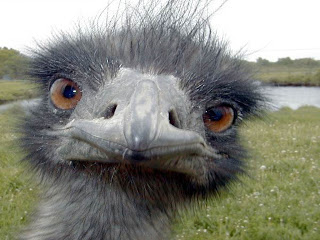 The Ostrich, officially named "Struthio camelus" is the largest of the 8,600 bird species, which exist today. Reaching a height of up to 2.6m these birds can weigh up to 135kg, cannot fly, but are very fast runners.
The long-held myth is that ostriches bury their head in the sand when they are frightened. The Canadian Museum of Nature's website states that- "If threatened while sitting on the nest, which is simply a cavity scooped in the earth, the hen presses her long neck flat along the ground, blending with the background. Ostriches, contrary to popular belief, do not bury their heads in the sand."
The term "sticking your head in the sand" has come to mean that you choose to ignore a bad situation, and hope that it will go away on its own. The unfortunate reality is that most of us take that action (really, a lack of action) when faced with a challenge. Sticking your head in the proverbial sand also prevents you from finding out more information that might help resolve the issue.
Every day I open the local newspaper to read about how people are affected by situations, how their life has become a living horror because of something that happened to them. Unfortunately most of these situations were preventable, but a lack of action allowed it to occur.
As children we are brought up with "A stitch in time saves nine" and "prevention is the best medicine", and these hold true for all of life's situations. The hard part is doing something about a potential future disaster rather than waiting for it to happen and then becoming involved in a stressful situation.
When you see something on your horizon take action now. Face your fears, get information, and move yourself to do something.
All too often we look at successful people and wonder how they get all the luck. I recently came across this a few weeks ago with a gentleman I worked with. He is in his fifties and recently moved away from Calgary into semi-retirement on Vancouver Island. He had just bought a boat and a large property overlooking the water.
Someone commented to me "Well it's alright for him. He has money!"
"Ahh yes!" I said, "but when he started dreaming about this ten years ago, he didn't. You're looking at his life nine and a half years into a ten year plan. No wonder it looks easy now, he's basically at the finish line."
No one became an "overnight success" without years of hard work before hand.
What was also interesting was how clear he could see his dreams even before they had materialised. Before he bought his boat he could visualise it, and he could even see where his dog would sleep. Having such a clear vision for what he wanted allowed him to know how to get there. He was able to take the right action because he knew where he wanted to end up. For many of us, it's having that clear vision of where we want to go that's the stumbling block.
When I asked the person who made the comment that this gentleman has "all the luck", I asked her what she wanted for her future. "To be happy," was the answer. But she couldn't tell me what "happy" looked like.
To make your future dreams become a reality it's important to imagine them, and see them clearly. You can't shoot for a goal that you can't see.
It's time to take our collective heads out of the sand, get informed, dream about our future and face our fears.
Monday, June 04, 2007
Taking A Risk (Published Article)
As a thirty-something Generation X’er, I am surrounded with friends who are in the midst of early-life crises. It seemed that for the Baby Boomers this crisis was “mid-life” in the forty to fifty age range. Now it seems to be happening earlier, because of all the opportunities we now have at our disposal.
This early-life crisis that seems to strike between 25 and forty is generally work or career related and the number of people I know personally who have made a complete change of career, gone back to study or taken extended leave to travel the world before 35 is amazing.
I’ve done all three.
What I noticed about my life and about others is how they become energized during and after this change. This energy is what carries you through the upheaval, and the fresh new energy afterwards is a sign that you’re on the right track. That’s enthusiasm for life.
Dale Carnegie said, “Enthusiasm is more than just zest for work. It is for the whole of life and living. If you have it, you have a priceless possession. Cherish it.”
I believe that enthusiasm for life comes when you are living your dream. Deep down we all know what we would do “in an ideal world”. For many of us it takes a personal tragedy or a life-threatening illness to make us change the way we live, to set us on the right track. A friend of mine in his late thirties, quit his high-paying, stressful job to chase his dream after he saw his brother die in a car accident.
If you’re thinking that you don’t feel enthusiastic about your job or your life, I’m sure you can find at least one thing that you’re enthusiastic about. Maybe it’s spending time with grandchildren, walking the dog, golfing, volunteering at church, working in the garden, skiing… it doesn’t matter. Think of that one thing, or the many things that get you excited. That’s the feeling you’re looking for; that feeling of anticipation when you start a new and exciting job, the thrill of a first date, or the excitement of seeing or learning something new.
It’s a great feeling when the path you’re taking in your life is completely in synch with your hopes and dreams. It’s not that difficult to be there. It’s all about making some decisions. Decide what it is you want in your life and what you don’t. One piece at a time, add or remove the respective aspects to your life.
The only catch is you’ll have to take a risk. This is obvious, really, because the risks you have taken so far in life had got you where you are today. To get somewhere else tomorrow, you’ll have to do something different, also known as taking a risk.
In my personal experience of taking risks, and from those I’ve observed, I see that risk-taking is nearly always a positive experience. Win, lose or draw, taking a risk means personal growth and perhaps a new perspective. I can attribute nearly all of the greatest experiences in my life to times when I took a risk. The bigger the risk, it seemed, the bigger the pay-off. Of course if a risk is taken and the result appears to be negative, it’s how we deal with that result that has the greatest effect on our life.
Thomas Edison discovered 10,000 ways not to invent a light bulb, before he found the right way. From Abraham Lincoln to Donald Trump, there are countless examples of hugely successful people who all took risks and failed, but picked themselves up and continued on.
Unfortunately for many of us, it takes only one small setback and we abandon chasing our dreams, relegating them to “unattainable dream” status.
In this respect we can learn a lot from children. Their life is all about experiments, taking risks, doing things they’ve never done before, falling down, getting hurt, but nevertheless, trying again until success presents itself.
Take a leaf out of a child’s book and take a risk! Go for it! Your life will never be the same again!
This early-life crisis that seems to strike between 25 and forty is generally work or career related and the number of people I know personally who have made a complete change of career, gone back to study or taken extended leave to travel the world before 35 is amazing.
I’ve done all three.
What I noticed about my life and about others is how they become energized during and after this change. This energy is what carries you through the upheaval, and the fresh new energy afterwards is a sign that you’re on the right track. That’s enthusiasm for life.
Dale Carnegie said, “Enthusiasm is more than just zest for work. It is for the whole of life and living. If you have it, you have a priceless possession. Cherish it.”
I believe that enthusiasm for life comes when you are living your dream. Deep down we all know what we would do “in an ideal world”. For many of us it takes a personal tragedy or a life-threatening illness to make us change the way we live, to set us on the right track. A friend of mine in his late thirties, quit his high-paying, stressful job to chase his dream after he saw his brother die in a car accident.
If you’re thinking that you don’t feel enthusiastic about your job or your life, I’m sure you can find at least one thing that you’re enthusiastic about. Maybe it’s spending time with grandchildren, walking the dog, golfing, volunteering at church, working in the garden, skiing… it doesn’t matter. Think of that one thing, or the many things that get you excited. That’s the feeling you’re looking for; that feeling of anticipation when you start a new and exciting job, the thrill of a first date, or the excitement of seeing or learning something new.
It’s a great feeling when the path you’re taking in your life is completely in synch with your hopes and dreams. It’s not that difficult to be there. It’s all about making some decisions. Decide what it is you want in your life and what you don’t. One piece at a time, add or remove the respective aspects to your life.
The only catch is you’ll have to take a risk. This is obvious, really, because the risks you have taken so far in life had got you where you are today. To get somewhere else tomorrow, you’ll have to do something different, also known as taking a risk.
In my personal experience of taking risks, and from those I’ve observed, I see that risk-taking is nearly always a positive experience. Win, lose or draw, taking a risk means personal growth and perhaps a new perspective. I can attribute nearly all of the greatest experiences in my life to times when I took a risk. The bigger the risk, it seemed, the bigger the pay-off. Of course if a risk is taken and the result appears to be negative, it’s how we deal with that result that has the greatest effect on our life.
Thomas Edison discovered 10,000 ways not to invent a light bulb, before he found the right way. From Abraham Lincoln to Donald Trump, there are countless examples of hugely successful people who all took risks and failed, but picked themselves up and continued on.
Unfortunately for many of us, it takes only one small setback and we abandon chasing our dreams, relegating them to “unattainable dream” status.
In this respect we can learn a lot from children. Their life is all about experiments, taking risks, doing things they’ve never done before, falling down, getting hurt, but nevertheless, trying again until success presents itself.
Take a leaf out of a child’s book and take a risk! Go for it! Your life will never be the same again!
Friday, May 04, 2007
The Secret (Published Article)

I'm sure many of you had seen the movie or read the book "The Secret". It's a very well marketed concept, but the interesting thing is that nothing in there is really revolutionary, and neither does it claim to be.
Briefly, “The Secret” is the Law of Attraction, which states that you will attract into your life what you think about, whether it is positive or negative. Your thoughts determine your destiny.
What I found interesting was that so many people underestimate the power of intention and positive thoughts. Look around in your own life at what you have. What you see physically in your world - your friends, relationship, job, possessions, wealth etc are all a manifestation of your emotional, spiritual and physical well being. For example, if you are emotionally depressed, you may have very few friends. If you believe that "money is evil" then you are unlikely to be rich. If you don't place health as a priority in your life you may be overweight or underweight and unfit.
To change anything on the outside, we must first change on the inside. You won't become fit and healthy if you don't have the internal desire. You won't become wealthy if you think about being poor.
After changing our attitude, we must then change our actions. Ideas or words without actions will produce little more than ideas alone.
Colonel Harland Sanders, the founder of Kentucky Fried Chicken, started the business as a retired man with a small pension and an old car, but with a chicken recipe he knew in his heart was a winner. He approached restaurant owners and planned to sell his chicken recipe to them. In return they would give him a residual for every piece of chicken they sold - 5 cents per chicken.
The first restaurateur he called on turned him down. So did the second, and the third. In fact, the first 1008 sales calls Colonel Sanders made ended in rejection. Still, he continued to call on owners as he traveled across the USA, sleeping in his car to save money. Prospect number 1009 gave him his first "yes" and after two years of making daily sales calls he had signed up a total of five restaurants. Still Harland pressed on, knowing that he had a great chicken recipe and that someday the idea would catch on. The Colonel's smiling face in so many cities across the world shows that the idea did catch on. Colonel Sanders franchise actually helped many people succeed in the restaurant business.
Colonel Sanders had an idea, and a positive attitude that his idea would succeed. But the path to success isn't just about wishful thinking. Success is due to action, action and more action.
I guess my point is that some people criticize “The Secret” because it seems so abstract. I don’t think any of those people in the movie are saying that by thinking about something it will magically appear. What does happen is that thinking certain thoughts will put you in the correct frame of mind to see certain opportunities and then have the courage and foresight to act correctly to make the dreams materialize.
The secret to a happy and successful life lies in, firstly, knowing exactly what you want, and secondly focusing your attention on achieving that. Setting goals and making time to achieve them is the best way to advance forward.
Every day when you wake up you begin the rest of your life. Every morning you decide how you will live that day. You choose your own life and your destiny.
Monday, April 02, 2007
The Value of Time (Published Article)
Have the words “I just don’t have enough time” ever passed your lips? Have you ever wished for an extra one or two hours in the day?
It seems to be a common problem, but it’s not that there isn’t enough time, it’s that the time we have available isn’t being used efficiently.
Time isn’t something we can change, but our use of it is. Somehow people like Donald Trump seem to find enough time, so how can we squeeze a little more out of the orange?
Firstly, consider how important time is for you, and how much time is wasted every day. I treat my time like a scarce commodity, because I’m never sure just how much more of it I’ll have. Time is my only non-renewable resource.
If you work full-time, then you’re donating forty or more hours per week. Unless you can increase your hourly rate or decrease your expenses, this time spent is a given.
But what about the rest of your time?
A year or so ago my life came to a crunch. I felt I was close to a breakdown because I was overdoing it, committing to too many projects and trying to get too much done. What was disconcerting was that I felt I wasn’t giving enough attention to the parts of my life I valued most. I think most of us can relate to that.
So I wrote a list of the top ten ways I’d like to spend my time, and I compared it to the top ten ways I actually spent my time. The difference was staggering.
That was the day I gave up television.
Here are some of the ways I maximize the value I get from my time. I won’t spend time with people who don't appreciate me. I am continually trying to improve myself and my life and I actively enjoy the time I have doing what I place high on my priorities - reading, painting, exercising, socializing, writing, meditating, traveling, and most importantly being a Dad and husband.
An interesting statistic: The average Canadian watches television for 21.4 hours per week (source Stats Canada). Over a lifetime of say seventy-five years, that's 9 years and 193 days spent in front of the television.
Think about what you’ve achieved over the last nine or ten years and realize that’s what you might be giving up.
I didn’t watch 21.4 hours a week, but I had my weekly shows, and a few others I liked. But I saw how those shows got in the way of doing what I really wanted to do. Watching television wasn’t in my top ten.
By giving up television (I now watch between a half and one hour per week) my available time is more than nine years longer than the average Canadian.
On the other hand a fifty-year study completed in 2004 by BUPA's Health Information Team in the U.K. stated that smoking cuts life expectancy by ten years. So when you compare watching television to smoking, which continually gets bad press, you effectively miss out on about the same amount of time to actively live.
It's important that we not only respect our own time, but even more importantly, the time of others. It is only by being active in the time we have that we can accomplish and grow.
"I find television very educating. Every time somebody turns on the set, I go into the other room and read a book" - Groucho Marx (1890-1977)
If you have any comments, I’d like to hear them. Please email me at matthew@pagehanify.com
It seems to be a common problem, but it’s not that there isn’t enough time, it’s that the time we have available isn’t being used efficiently.
Time isn’t something we can change, but our use of it is. Somehow people like Donald Trump seem to find enough time, so how can we squeeze a little more out of the orange?
Firstly, consider how important time is for you, and how much time is wasted every day. I treat my time like a scarce commodity, because I’m never sure just how much more of it I’ll have. Time is my only non-renewable resource.
If you work full-time, then you’re donating forty or more hours per week. Unless you can increase your hourly rate or decrease your expenses, this time spent is a given.
But what about the rest of your time?
A year or so ago my life came to a crunch. I felt I was close to a breakdown because I was overdoing it, committing to too many projects and trying to get too much done. What was disconcerting was that I felt I wasn’t giving enough attention to the parts of my life I valued most. I think most of us can relate to that.
So I wrote a list of the top ten ways I’d like to spend my time, and I compared it to the top ten ways I actually spent my time. The difference was staggering.
That was the day I gave up television.
Here are some of the ways I maximize the value I get from my time. I won’t spend time with people who don't appreciate me. I am continually trying to improve myself and my life and I actively enjoy the time I have doing what I place high on my priorities - reading, painting, exercising, socializing, writing, meditating, traveling, and most importantly being a Dad and husband.
An interesting statistic: The average Canadian watches television for 21.4 hours per week (source Stats Canada). Over a lifetime of say seventy-five years, that's 9 years and 193 days spent in front of the television.
Think about what you’ve achieved over the last nine or ten years and realize that’s what you might be giving up.
I didn’t watch 21.4 hours a week, but I had my weekly shows, and a few others I liked. But I saw how those shows got in the way of doing what I really wanted to do. Watching television wasn’t in my top ten.
By giving up television (I now watch between a half and one hour per week) my available time is more than nine years longer than the average Canadian.
On the other hand a fifty-year study completed in 2004 by BUPA's Health Information Team in the U.K. stated that smoking cuts life expectancy by ten years. So when you compare watching television to smoking, which continually gets bad press, you effectively miss out on about the same amount of time to actively live.
It's important that we not only respect our own time, but even more importantly, the time of others. It is only by being active in the time we have that we can accomplish and grow.
"I find television very educating. Every time somebody turns on the set, I go into the other room and read a book" - Groucho Marx (1890-1977)
If you have any comments, I’d like to hear them. Please email me at matthew@pagehanify.com
Subscribe to:
Posts (Atom)